
Federal Boulevard
It’s time to fix Federal Boulevard.
The corridor is getting a makeover as early as 2030 with the addition of Bus Rapid Transit, but the current design may not live up to the potential of the corridor as a people-friendly main street without strong advocacy.
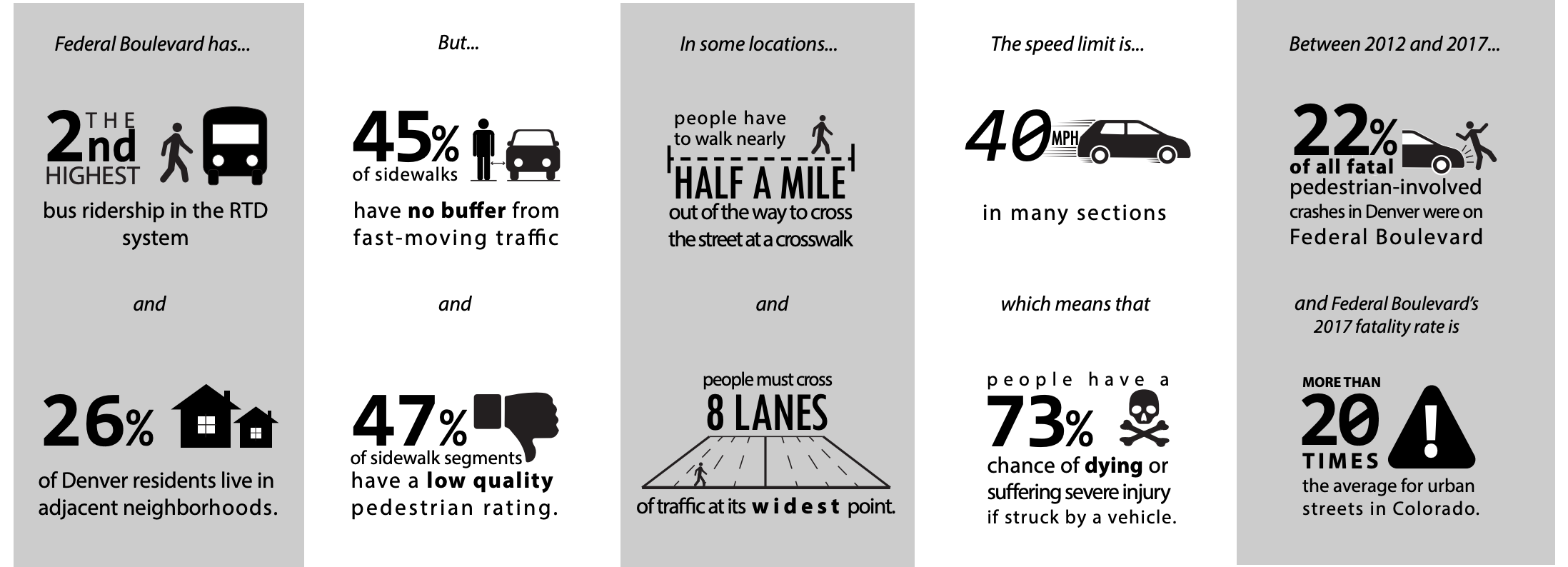
Federal Boulevard is a critical part of Denver’s transportation system.
What it is.
It is home to some of the most diverse neighborhoods in the city, including a mixture of immigrant, low-income, young adult and senior populations as well as established neighborhoods and college campus communities.
Federal serves as a main street for these communities, providing access to social services, numerous parks, and a plethora of cherished local minority-owned businesses.
What's the problem?
Federal Boulevard is the most dangerous street in Denver, with a fatality rate more than twenty times the average for urban streets in Colorado. Between 2012 and 2017, twenty-two percent of all pedestrian-involved crashes in Denver were on Federal Boulevard.
This traffic violence is preventable. City leaders acknowledged this with Denver’s commitment to Vision Zero and eliminating traffic fatalities and serious injuries on our streets. It’s time to back up this commitment with action.
Why it matters.
The victims of fatal crashes on Federal come from all walks of life, but their deaths have something in common: speed. Federal is designed to facilitate high-speed travel and people often drive well above the posted speed limit.
This is unacceptable for a major urban corridor lined with multifamily housing, schools, mom-and-pop businesses, parks, cultural destinations, social service providers, and major transit routes.
People should be able to enjoy one of Denver’s most vibrant urban streets without fear of injury or death.
Three steps to a safer Federal Boulevard.
Traffic calming
Raised, planted medians limit dangerous turning motions and slow traffic.
Pedestrian median refuges shorten crossing distances and provide a safe place to wait.
High-visibility, mid-block crossings provide safe connections to destinations.
Reduced turning radii slow turning vehicles and increase pedestrian space.
Bus Rapid Transit
Bus rapid transit (BRT) is like light rail on tires. In other words, it is an enhanced, high-frequency bus service that can move more people faster and more reliably than traditional bus service.
The Colorado Department of Transportation (CDOT) has identified Federal Blvd for BRT service because of its high ridership. People got on the bus along Federal Blvd 9,000 times every day in 2023. Currently, though, buses on Federal face significant delays because they’re stuck in traffic, which causes long travel times—almost 50% more than traveling by car. BRT will make bus service faster and more reliable on Federal, while reducing conflict between modes and calming traffic, but only if it’s implemented to the standards of true Bus Rapid Transit.
Speed safety cameras
A new state law gives Denver the opportunity to use photo enforcement more broadly to decrease reckless driving on dangerous streets like Federal Boulevard. Speed safety cameras are a proven technique used worldwide to reduce speed-related injuries and fatalities. When deployed effectively, they actually result in fewer citations as safer travel speeds become the norm.
Federal Boulevard Projects
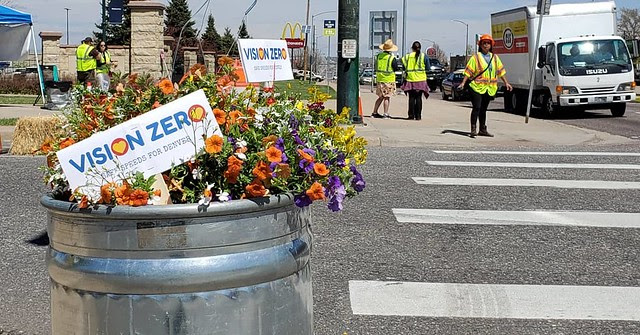
Pop-up Traffic Calming on Federal
Using cones, painted tires, beach balls, and hay bales, we hosted a pop-up demonstration at the intersection of Federal Blvd and 50th Ave complete with a temporary median, protected bike lanes, and curb extensions. Drivers slowed down and pedestrians said it made them feel safer. Next step: permanent installation by DOTI!
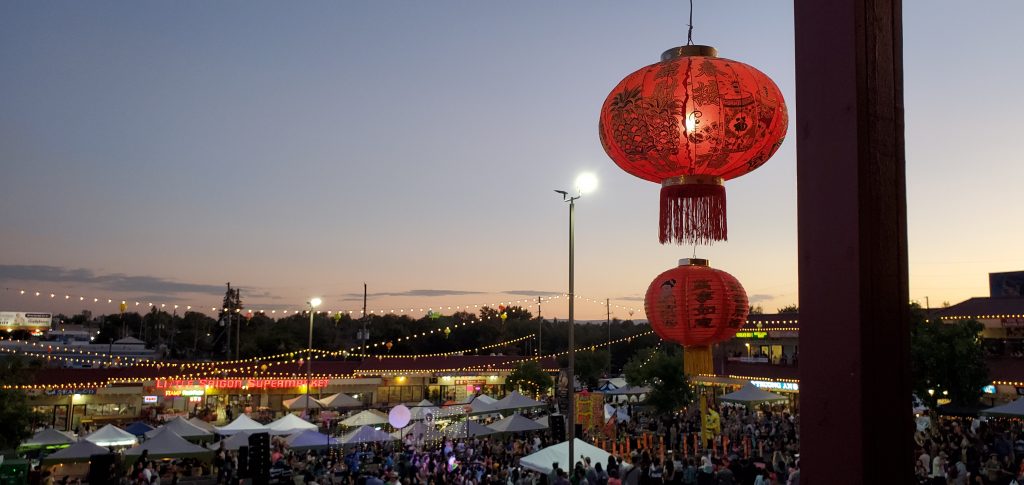
Friends of Little Saigon
We’re partnering with local businesses along South Federal Boulevard to celebrate the cultural diversity of this corridor while improving traffic safety and the pedestrian environment.
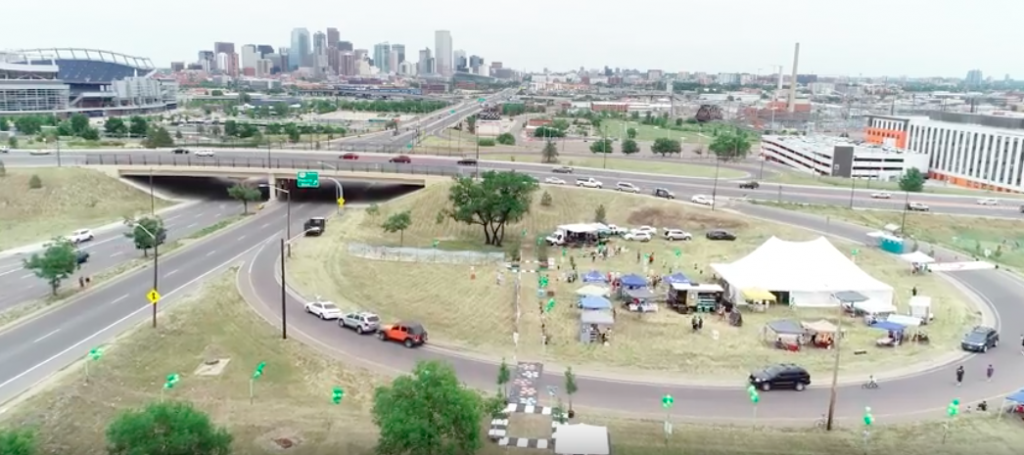
Over the Colfax-Federal Clover
We teamed up with the West Colfax Business Improvement District to launch the Over the Colfax-Federal Clover project as an effort to bring together community members and local experts to develop design solutions for an intersection that is currently unsafe and dangerous to navigate for all users.
Related Resources
Cultivate Health Walk Audit Final Report
Cultivate Health is a partnership among Regis University, private real estate developers Urban Ventures and Perry Rose,\ the Chaffee Park neighborhood, and)several nonprofit organizations. The goal of Cultivate Health is to support the health and wellness of residents living in the multigenerational. mixed income community within a four-census tract neighborhood adjacent to Regis University. This […]