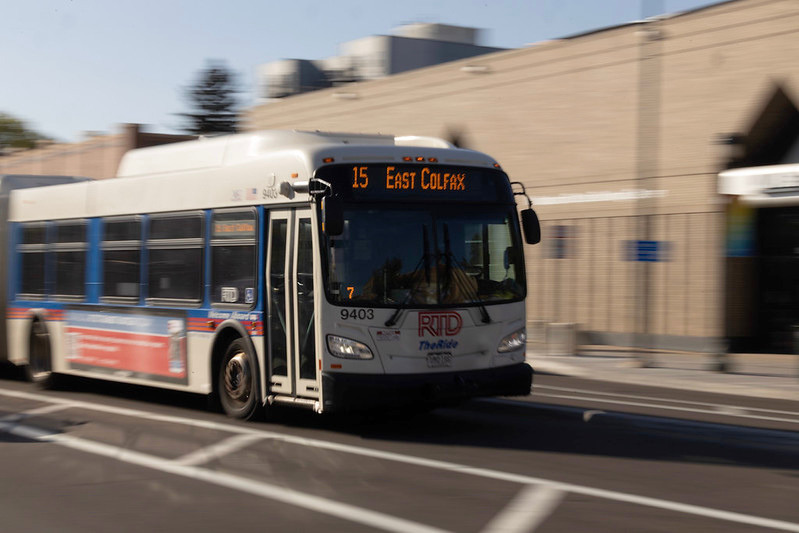
Denver region residents feel pretty “meh” about RTD’s bus system. Every year the transit agency conducts a community and customer survey and calculates an overall score that measures how likely people are to recommend RTD’s services to someone else. In 2025, this score for the bus system was 26, barely in the “favorable” range (21-50) and well below “excellent” (51-80) or “world class” (81-100).
The reasons behind this lack of enthusiasm are not mysterious: we’ve been disinvesting in and neglecting our bus system for decades. With the recently launched RTD Connect initiative, we have the chance to finally reverse course and work toward a bus system that is actually excellent, maybe even world class. Over the next year, this initiative will consider potentially big changes to where the bus routes go (redrawing the lines on the map), as well as service levels on each of the routes (how frequently the buses come).
Most people know that the multi-billion-dollar FasTracks initiative approved by voters in 2004 set out to build more than 120 miles of new rail transit. What a lot of people have seemingly forgotten is that FasTracks also included a commitment to create an “Enhanced Bus Network” that would add new bus routes and route adjustments to provide convenient connections, and increase bus service levels 30% between 2003 and 2025.
In 2013, however, RTD decided to divert funding for bus service improvements into a savings account for the unfinished rail corridors, which turned out to be way more expensive than originally estimated. By 2024, bus service was actually 17% lower than 2003, even though the region’s population has grown by 30%. The impacts of underinvestment have been profound.
While rail corridors are an important backbone for the transit network, buses are the workhorses of the system, accounting for about 65% of total ridership. Cutting bus service therefore has significant negative consequences, particularly as this service has become stretched increasingly thin across a very large geographic area.
Unlike peer transit agencies that focus their service on the parts of their region with the highest population density, RTD’s service area is enormous with a very low average population density. For example DART, the Dallas transit agency, has a service area of 698 sq miles with 3,450 people/sq mile, compared to RTD’s service area of 2,342 sq miles with only 1,247 people/sq mile. Routing a decreasing number of buses across such a large area means very few corridors have buses that come frequently enough – every 15 minutes or less – to be a truly practical option for most people. RTD’s own surveys find frequency is by far the most important factor that determines customer satisfaction.
Imagine if you owned a car, but it was in a locked garage that you could only access once an hour, and couldn’t access at all in the evenings or on the weekends. How useful would that car be for getting you the places you need to go each day? Unfortunately, that’s the equivalent level of transit service available in many parts of the RTD region today.
It’s not surprising then that RTD’s ridership was in a downward spiral even before the pandemic, which only made things worse by forcing further service cuts. The pandemic also changed travel patterns: while travel is back to pre-pandemic levels, people are making fewer trips to work during the traditional “rush hour” and making more trips throughout the day to shop, access services, visit friends and family, and for other purposes. Which means the FasTracks rail service that RTD has been prioritizing, which was designed to get people from the suburbs to downtown for 9-5 jobs, doesn’t really match how people are trying to get around today.
The bottom line is that, more than 20 years after voters approved the FasTracks initiative, we are long past due for a new transit vision for the Denver region. Fortunately, the RTD Connect initiative can help inform that vision by taking a hard look at our existing bus network, and asking a few key questions:
- How can the system be redesigned to better serve our region’s needs today, within RTD’s existing financial constraints?
- If RTD had more revenue (e.g., if voters approved another ballot measure), how could those funds be used to create a truly great transit system?
Here’s our recommendations on the principles that should guide a new transit vision for the Denver region:
- Maximize ridership, rather than geographic coverage
- Maximize the usefulness of transit service through
- Frequency – buses and trains that come every 15 minutes, from early in the morning until late at night, 7 days a week.
- Speed – transit travel times that are competitive with driving.
- Reliability – high on-time performance and predictable travel times.
- Maximize cost efficiency
- Focus high-frequency, fixed-route service in high ridership areas
- Fund local governments to pursue local solutions that ensure access for those who need it the most in lower-ridership areas (e.g., microtransit, subsidies for Uber/Lyft, etc.)
- Capture a greater diversity of trip types beyond traditional 9-5 commuting trips.
- Prioritize high-frequency service for equity populations including low income households, households without cars, people with disabilities, and people of color.
If this sounds like the kind of vision you’d like to get behind, sign up to receive updates from the Denver Streets Partnership on the RTD Connect initiative and opportunities to advocate for a better bus system!