
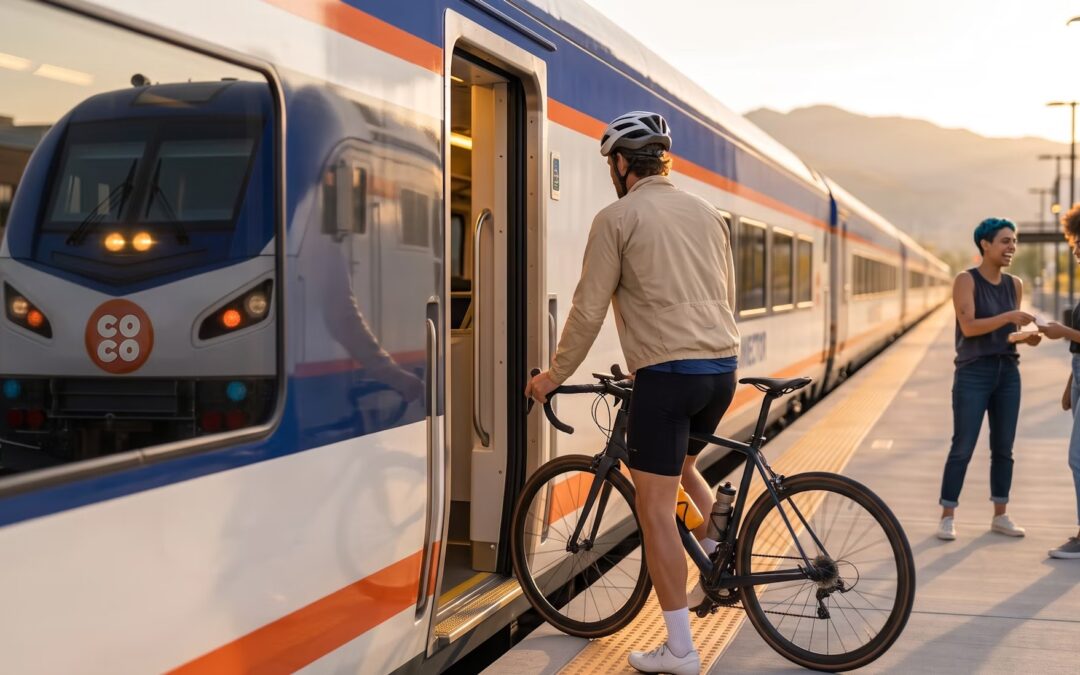
This November is an important opportunity for residents of Denver and other communities along Colorado’s Front Range to show strong support for better transit service. Ballot measure 7A asks voters to approve a 0.333% sales tax increase – equal to one-third of a penny on a $1 purchase – to fund the Colorado Connector (CoCo), an express intercity passenger train providing service to 12 stations between Fort Collins and Pueblo, with Denver Union Station as the hub.
As part of our mission to reduce Denver’s unsustainable dependence on cars, the Denver Streets Partnership has long advocated for the increased funding needed to support local transit that is fast, frequent, and reliable. People deserve a practical and attractive option for getting to daily destinations like work, school, and shopping without driving. The plans for CoCo would complement this kind of excellent local transit, giving people a viable alternative to driving on I-25 and adjacent highways for trips between cities.
Although local trips account for the majority of travel that happens every day, investing in intercity transit can also offer major benefits both by shifting car trips to rail and, more significantly, catalyzing more compact, mixed-use development around the rail stations. This in turn can help reduce car dependency in communities all up and down the Front Range.
Taking these combined effects of both transit improvements and land use changes into account, our friends at the Southwest Energy Efficiency Project (SWEEP) estimate that the potential benefits of CoCo include reducing GHG emissions by roughly 124,500 metric tons per year by 2045 and eliminating nearly 233 million vehicle miles traveled (VMT) annually – the equivalent of taking 29,000 gas-powered cars off the road. Fewer cars on the road for these intercity trips means less pressure to continually expand highways, helping prevent even more funds from being diverted away from local transit and other multimodal projects.
While CoCo by itself won’t fully address the need for improved local transit service here in Denver, it’s an important step in the right direction and an investment in creating more sustainable, livable, and connected communities throughout our state. Furthermore, overwhelming voter support for the initiative would help build momentum for future funding initiatives that would allow our local transit agency, RTD, to move beyond its current scarcity mindset, so that we can have great transit both locally AND between cities.
We therefore encourage you to learn more about the plans for CoCo and cast your ballot in favor of better transit this November by voting YES on 7A.