
April 28, 2026
Dear Executive Director Lew,
On behalf of the undersigned organizations and community members, we write to urge the Colorado Department of Transportation (CDOT) to deliver true bus rapid transit (BRT) on Colorado Boulevard by committing to dedicated, continuous bus-only lanes along the entire corridor.
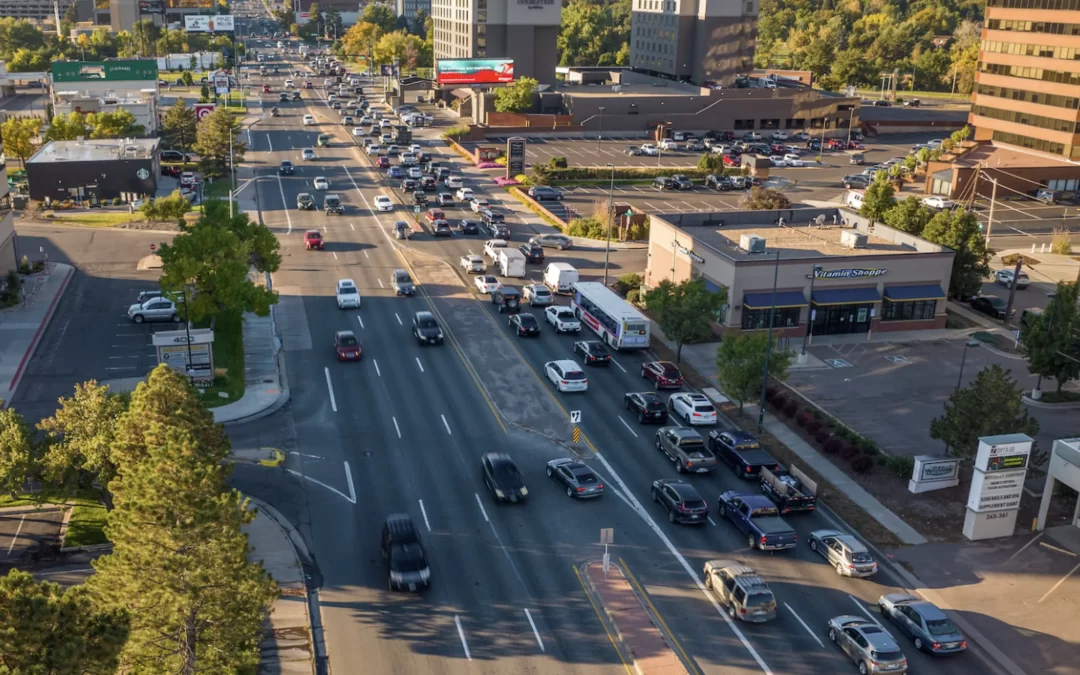
Colorado Boulevard is one of the most important corridors on Denver’s east side, linking the northern and southern edges of the city and connecting Denver with Glendale. Yet today, it operates less like a main street and more like a dangerous highway, prioritizing vehicle speed and throughput at the expense of safety, accessibility, and reliability for everyone traveling along the corridor. People walking, rolling, biking, and taking transit in particular face daily hazards and delays, while businesses along the corridor are cut off from the foot traffic that helps them thrive.
Colorado Boulevard’s current design is the result of decades of incremental changes aimed at moving more cars, faster. The outcome is a corridor that is congested, unsafe, and inefficient for the people who rely on it. It is also one of the most dangerous streets in the region, part of the high-injury networks identified by both the Denver Regional Council of Governments and the City and County of Denver. According to CDOT data, an average of 18 people are killed or seriously injured in traffic crashes on Colorado Boulevard every year.
While people walking, rolling, and biking were involved in only a small share of total crashes, they account for a disproportionate share of the most severe outcomes. Pedestrians and bicyclists must often cross six or more lanes of traffic, sometimes spanning over 100 feet, with safe crossings spaced far apart. Furthermore, Colorado Boulevard carries one of RTD’s busiest bus routes, yet buses are routinely delayed in mixed traffic, resulting in slow, unreliable service that undermines ridership and limits access to opportunity.
CDOT now has a critical opportunity to reshape Colorado Boulevard through its ongoing alternatives analysis. This work builds on a strong foundation of regional and local plans—including the DRCOG 2050 Regional Transportation Plan, Denver Moves Transit, RTD’s BRT Network Feasibility Study, and CDOT’s own 10-Year Vision—that all call for high-quality transit on this corridor.
At the same time, complementary investments like the voter-approved Vibrant Denver Bond will fund projects such as the 303 ArtWay Heritage Trail, increasing the number of people walking and biking along and across Colorado Boulevard. New transit-oriented development, including more than 1,000 new homes along with commercial and retail space at 9th and Colorado, is also increasing the demand for non-automobile travel along the corridor. The area is rapidly evolving from a car-dependent highway for through-traffic to a destination with walkable neighborhoods, with a lot more potential mixed-use development on the horizon. These investments and development projects will only succeed if the corridor itself becomes safer and more accessible.
We are concerned that some of the options under consideration—particularly buses operating in mixed traffic—would fail to deliver meaningful improvements. Without dedicated right-of-way, BRT becomes little more than today’s bus service with a new name. To realize the full benefits of BRT, CDOT must commit to the following:
- Dedicated bus lanes along the entire corridor, achieved by converting existing general-purpose traffic lanes to bus-only use
- Center- or side-running configurations that physically and operationally prioritize transit
- Transit signal priority to reduce delays at intersections
- High-quality stations with level boarding and off-board fare payment
- Frequent, all-day service that makes transit a convenient choice at any time–every 5–10 minutes, from early morning through late evening, on weekdays and weekends
- Safer, more comfortable pedestrian and bicycle infrastructure, including wider sidewalks, trees or landscaped buffers between people walking and moving traffic, and frequent crossings
- Traffic calming measures, such as narrower lanes, to support safer vehicle speeds
Among these, dedicated bus lanes are the essential ingredient. Without them, buses will remain stuck in the same congestion as general traffic, and the corridor will continue to fall short of its potential. Conversion of general purpose-traffic lanes to bus-only use is also critical for improving safety, by reinforcing safer speeds and reducing pedestrian exposure to traffic when crossing the street.
Implementing true BRT on Colorado Boulevard is fully aligned with CDOT’s goals to improve safety, reduce congestion, expand travel choices, and lower emissions. It is also a necessary step toward achieving local and regional Vision Zero commitments to eliminate traffic fatalities and serious injuries. This is not simply a transit project. It is an opportunity to transform Colorado Boulevard into a corridor that works for everyone: a place where people can move safely, businesses can flourish, and transit riders can depend on fast, reliable service.
We respectfully urge CDOT to advance a BRT alternative for Colorado Boulevard that includes continuous, dedicated bus-only lanes for the full length of the corridor, supported by the complementary features outlined above. Anything less risks perpetuating the very problems this project is intended to solve.
We appreciate your leadership and your commitment to creating a safer, more equitable, and more sustainable transportation system for Colorado. We look forward to working with you to ensure that Colorado Boulevard becomes a model for what great transit—and great streets—can look like.
Sincerely,
Jill Locantore, Executive Director
Denver Streets Partnership
Peter Piccolo, Executive Director
Bicycle Colorado
Jaime Lewis, Transit Advisor
Colorado Cross-Disability Coalition (CCDC)
Renee Larrarte, Climate & Transportation Campaign Manager
Conservation Colorado
Danny Katz, Executive Director
CoPIRG
Rob Toftness, Co-founder
Denver Bicycle Lobby
Coleen Samuels, Executive Director
Denver Regional Mobility & Access Council (DRMAC)
Saigopal Rangaraj, Co-Lead
Greater Denver Transit
Alana Miller, Colorado Policy Director
NRDC (Natural Resources Defense Council)
Alejandra X. Castañeda, Co-organizer, Denver Metro Area
Pedestrian Dignity
Rudolph Gonzales, President & CEO
Servicios de La Raza
Alvina Vasquez, Board Chairperson
Servicios Sigue
Matt Frommer, Transportation & Land Use Policy Manager
Southwest Energy Efficiency Project
Tyler Winstead, Vice President
Strong Denver
Becky English, Chair, Colorado Sierra Club Transportation Committee
The Sierra Club
Rob Greer, Steering committee member
YIMBY Denver
Hassan Alissa, Owner
Kabob House
Jamie Perkins, Owner
Twist and Tumble Kids Gymnastics