
East Colfax Parking Management Study
This study brought together community stakeholders to propose a coordinated approach to managing parking along the East Colfax corridor, with the goal of maximizing the benefits of the forthcoming bus rapid transit (BRT) service.
Study Overview
The East Colfax Parking Management Study brought together a Steering Committee of residents, businesses, nonprofits, city leaders and agency staff to propose a coordinated approach to managing parking along the corridor, with the goals of maximizing the benefits of the forthcoming bus rapid transit (BRT) service, encouraging people to travel the corridor without driving, and ensuring parking is available for those who truly need it. The Steering Committee’s recommendation to pilot a Parking Benefits District on East Colfax promises to serve as a model that can be replicated on other BRT corridors and in vibrant commercial areas across the city.
The study included an analysis of the current parking inventory [PDF] along the corridor, an extensive community survey [PDF], and research on best practices from around the country. Click on the links below for more information, or read the full report [PDF].
Read our blog post:
“Parking with Benefits”: How smarter parking management can help improve walking, biking, and transit
What was the purpose of the study?
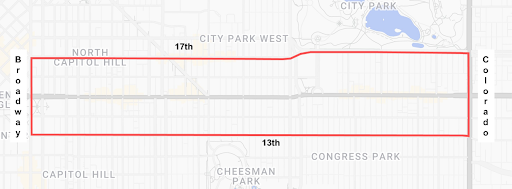
The purpose of the study was to develop a coordinated approach to managing demand for on- and off-street parking along the East Colfax corridor, and to explore opportunities for additional programs that increase awareness of and access to mobility options, with the goal of maximizing the benefits of bus rapid transit (BRT) and encouraging residents, employees, and visitors to travel the corridor without driving. Consistent with the planned BRT, the study focused the corridor from Broadway to Yosemite, and from 13th Avenue to 17th Avenue, with a particular emphasis on the section of Colfax from Broadway to Colorado where parking demand is the greatest, as shown on the map below.
Who was involved in the study?
The Denver Streets Partnership convened a Steering Committee with representatives from neighborhood associations, business districts, city council members, and public agencies to guide the study, with technical assistance from Sustainable Urban Planning Advisors. The DSP sought broader community input from residents, business owners, employees, and visitors to the corridor through surveys and other methods.
Steering Committee Members:
- Amanda Sawyer, Denver City Council District 5
- Anne Kuechenmeister, Bluebird Business Improvement District
- Brendan Greene and Helen Tekle, East Colfax Community Collective
- Brittni Joy West-Ware, Capitol Hill United Neighbors
- Chris Hinds, Denver City Council District 10
- Darrel Watson, Denver City Council District 9
- Doug Monroe, Regional Transportation District
- Ellen Roth, South City Park Registered Neighborhood Organization
- Frank Locantore, Colfax Ave Business Improvement District
- Jo Untiedt and Scott Holder, City Park West Registered Neighborhood Organization
- Karly Andrus, Northeast Transportation Connections
- Max Gesten, Downtown Denver Partnership
- Monica Martinez and Veronica Choncas, The Fax Partnership
- Nathan Pope and Scott Burton, Denver Department of Transportation and Infrastructure
- Ryan Noles, Colorado Department of Transportation
- Sarah Parady, Denver City Council At Large
- Stuart Anderson, Transportation Solutions
- Sue Baldwin and Ian Harwick, Denver Department of Climate Action, Sustainability, & Resilience
- Tate Carpenter, Denver Parks and Recreation Advisory Board Member, District 10
- Tony Lechuga, Denver Department of Community Planning and Development
Why is parking management important?
Extensive research has shown that excessive and poorly managed parking increases car ownership and driving, which in turn works against Denver’s goals related to environmental sustainability, equity, safety, and expanded mobility options. The plans for center-running BRT service on East Colfax Avenue include the removal of approximately 300 of the current 970 on-street parking spaces, and omits the construction of park-and-rides on this multimodal corridor. Strategic parking management will therefore be essential for the successful transformation of Colfax into a more transit-oriented corridor, where local businesses can thrive and the majority of trips are made by modes other than driving. As the City builds out a full network of BRT routes connecting neighborhoods across Denver, parking management strategies that prove successful on Colfax can be expanded to other corridors as well.
How does this study relate to other recent planning efforts?
The City and County of Denver recently completed a Curbside Access Management Plan for the area from Broadway to Colorado Boulevard and from 17th Avenue to 13th Avenue. This plan identified strategies for regulating the supply of on-street parking through the designation of loading zones, metered parking, and time-limited parking zones. Recent legislation passed by both Denver and the State Legislature modified parking requirements for new development along Colfax, with the goal of promoting more pedestrian- and transit-friendly development.
The DSP-led parking management study built on this work by considering strategies for managing parking demand through mechanisms such as demand-based pricing, as well as coordinated management of existing on- and off-street parking. The study also explored opportunities to invest parking revenues into programs and projects that increase awareness of and access to mobility options, such as EcoPasses; micromobility (scooter and bike share) subsidies; secure bike parking and other amenities near transit stops; streetscape improvements; and maintenance.